


Aydınlatma metni yükleniyor…
When you save a wedding dress photo, give it a two-line caption of your own. Use the first line for something you can see and the second for something you need to try. “I like the way the skirt opens out from the waist. How much fabric will I have on my lap at dinner?” That note gives a stylist more to work with than a camera roll full of beautiful gowns. Here is how to turn a folder of inspiration into three dresses worth trying for three different reasons.
Picture one part of your wedding day
Choose a moment you can describe in ordinary language. Perhaps you will walk down four stone steps holding a handrail, lean across a register to sign your name, or sit beside your partner on a narrow bench. A detail like “I want one hand free on the steps” immediately gives you something to ask about a skirt or train. It also leaves room for very different dresses to meet the same brief.
As you browse a fashion publication such as Nicest Deals, keep two collections. Save dresses you can imagine wearing on the day in one and individual details you love in the other. A photo of a long train might earn its place in the second folder because you love the square neckline. Label it accordingly and your stylist can show you that neckline on a gown with a shorter hem.
Compare three silhouettes from the same angle
Start with full-length front views and scale each image to roughly the same height on your screen. Look for the waistline, the point where the skirt begins to stand away from the body, and the width of the hem. Use the same three reference points across the wedding dress styles you save. They help you pick out a shape even when the photographer, venue and lighting change from one picture to the next.
| Silhouette | What to look for in the photo | One question for the appointment |
|---|---|---|
| A-line | A gradual flare from waist to hem | Do I need a hand on the skirt when turning? |
| Sheath | A narrow outline below the hip | Can I take my usual stride and sit comfortably? |
| Ball gown | Fullness beginning just below the waist | Where does the skirt settle as I pull up to a table? |
The three dresses in the cover illustration have similar necklines and colours. Follow the line down from each waist. On the left the skirt widens gradually, in the middle it falls close, and on the right the volume starts just below the seam. Now look at the picture a second time and notice where your eye goes first. You might have been searching for a “simple dress” when what you really like is an unembellished bodice. That discovery opens up more choices for the skirt.
Read texture up close and proportion at a distance
A fabric close-up answers a different question from a full-length photograph. In the illustration below, a broad band of light runs over the fold of satin on the left. The fold in the matte crepe at the centre reads mostly as shadow. On the right you can see the table through the tulle and trace the outline of a floral appliqué. Pick the surface that draws your eye, then leave a question about weight, lining or feel for an actual sample.
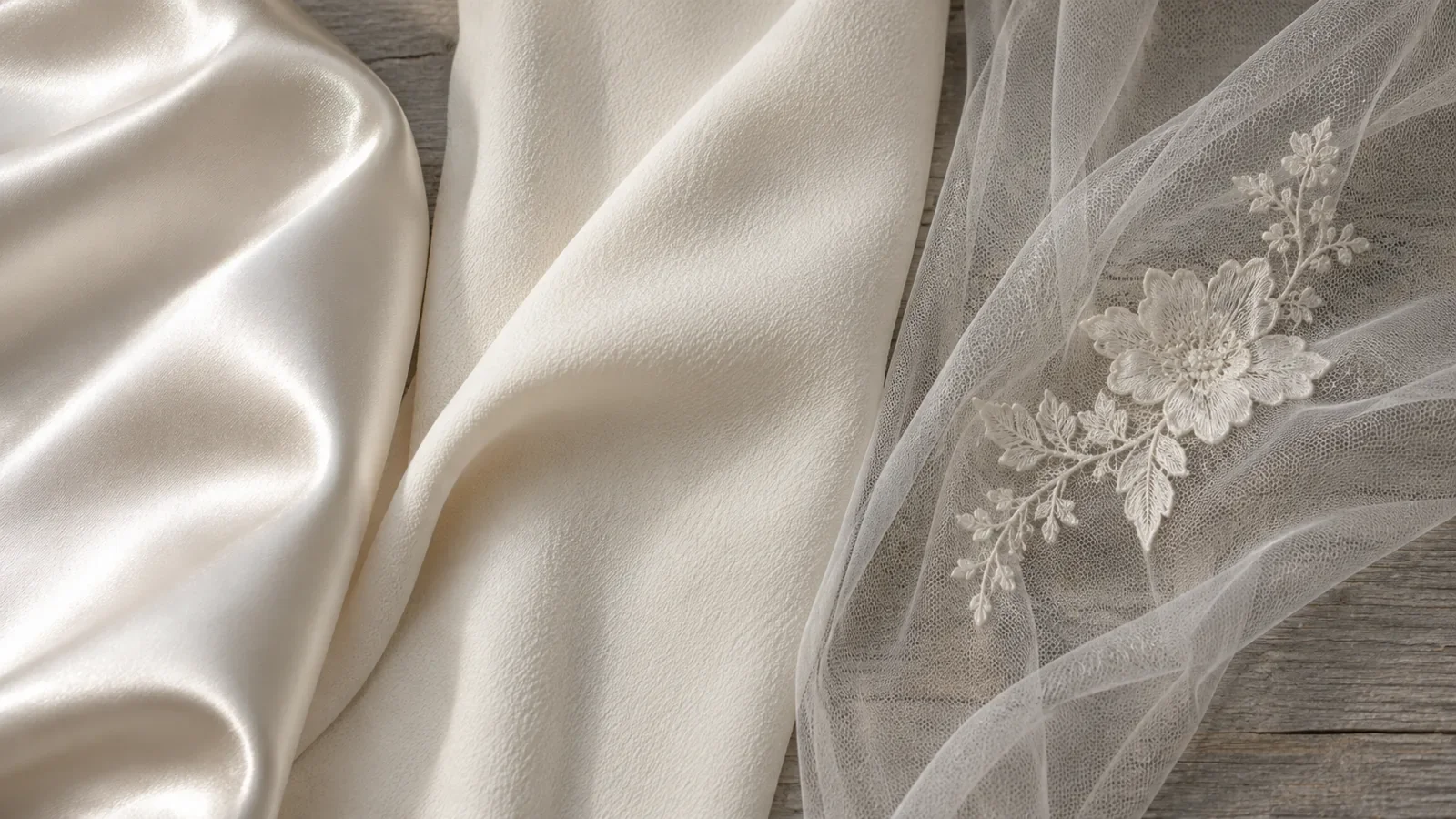
This distinction is particularly useful for lace. A single flower at the shoulder can fill an entire detail shot. Seen from across a room, a trail of the same flowers down the skirt may draw your attention to a different part of the dress. Pick a full-length view and a detail shot from these lace wedding dress necklines and backs. Decide whether you want a few distinct motifs on the back or a smaller repeating pattern over the skirt. Bring both views if placement matters to you.
Name what the picture leaves out
The closer you come to booking an appointment, the more valuable a side or back view becomes. If a train runs out of the frame, ask to see it spread out and fastened up for the evening. If a model poses with both hands on her waist, you still have a question about how the armhole looks with her arms relaxed. You can now look for one useful missing view rather than collecting another dozen versions of the same pose.
Be careful about changing several things at once in a comparison. A front view taken in daylight without a veil can feel quite different from a side view under spotlights with a cathedral veil. Preferring the first picture tells you little about the cut in isolation. Name the biggest difference you notice. Look for that second dress without a veil or in softer light. If your preference holds, you have a much clearer idea of the feature you want to try.
Give each dress on your shortlist a job
Let the first gown represent the shape you already like. For the second, change one feature while keeping the others fairly close. Give the third spot to something a photograph cannot settle for you. You could choose a square-neck A-line, a slimmer dress with a similar neckline, and a gown with a removable overskirt. Write a different question next to each one before you make the appointment.
Imagine a ceremony in a small room, dinner on a lawn and a gravel path between them. In the A-line gown you might want to find out how to gather the skirt for the walk. In the slim dress, sit in a dining chair and turn to speak to the person beside you. For the detachable overskirt, ask who would help you remove it and where you would leave it. By the end you have answers about your day as well as pictures of three dresses.
Copy the note below into your phone. A single observation per line is enough. Fill it out before you ask anyone else for their favourite. Someone who came with you can often give better feedback to a specific question such as “Which skirt did I stop adjusting once I started walking?” than to a request to pick the dress for you.
- Style name or number __________________
- Detail I liked in the photo __________________
- A movement from my wedding day __________________
- What I noticed when I tried it __________________
- Question still open __________________
Separate a shopping appointment from an alterations fitting
At a shopping appointment you are exploring styles. With the salon’s permission, walk a few steps, sit down, stand up and reach forward as if greeting a guest. If you keep adjusting the dress, note exactly where. A sample may be clipped to fit for the appointment. Ask the stylist what the clips are doing before deciding that a fold or a pull is an inherent feature of the design.
At an alterations fitting the conversation shifts to the length and fit of a specific gown. Kleinfeld, for example, asks brides to bring their wedding shoes when the hem is being fitted. Check the instructions from your own fitter. If you expect to change into flats for the reception, mention the second pair while discussing the hem. Seeing both heights with the dress gives you something concrete to base a decision on.
What makes a bridal guide easier to use on a phone?
If you publish fashion content, try this exercise on a single page. Give the reader one full-length view and one close-up. Caption each with a detail visible in that particular frame. If the heading promises a square neckline and the picture shows only the back, match the photograph to the question it actually answers. Keep the caption close enough that a reader on a phone can tell which gown it describes.
You can test the page with one practical request. Ask a reader to identify one difference between two dresses and write down a question for a stylist. Listen to the words they use and notice where they scroll back to check a detail. Their answer tells you which comparison the page made possible and where a missing view got in the way. Kumsal Ajans explores this decision-making problem more broadly in its article on UX research for choosing among many options.